

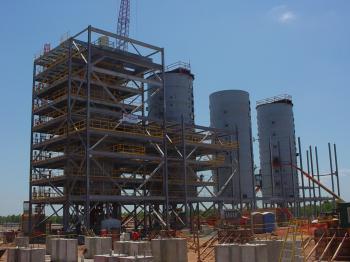
Having built or repaired over 300 of the 500 American Multiple Hearth Furnaces (MHFs) in existence, our experience has kept us aware of the issues and concerns of multiple hearth furnace owners and operators. We have constructed and rehabilitated Multi Hearth Furnaces in 47 American States (including Alaska), Puerto Rico, Canada, Europe, Asia and South America. As a result, we have seen numerous failure mechanisms and have brought long term solutions to these problems. View some of our more notable multiple hearth furnace projects.
Contact Us for More Information on Multiple Hearth Furnaces
FAQs About Multiple Hearth Furnaces
What are the key features of a multiple hearth furnace?
A multiple hearth furnace features a series of vertically stacked hearths that create separate processing zones within one compact unit. Material moves continuously from hearth to hearth using a rotating center shaft, rabble arms, and teeth, allowing precise control over temperature, atmosphere, and residence time. Key benefits include efficient thermal processing, high production capacity, a relatively small footprint, low maintenance requirements, and the ability to handle processes such as drying, calcining, oxidation, and reduction.
Learn more about the design, operation, and benefits in our Multiple Hearth Furnace 101 guide.
What are the key applications of multiple-hearth thermal processing units?
Multiple hearth thermal processing units are used for a wide range of industrial processes, including calcining, drying, oxidation, reduction, pyrolysis, and material recovery. Their ability to maintain different temperature and atmosphere conditions across multiple hearths makes them well suited for processing minerals, metals, carbon-based materials, and other industrial products.
Learn more about the technology and in our Multiple Hearth Furnace 101 guide or MHF’s numerous applications.
How does a multiple hearth furnace compare to other industrial furnaces?
Compared with many other industrial furnaces, a multiple hearth furnace provides multiple controlled processing zones within a single unit, allowing greater control over temperature, atmosphere, and material residence time. Its vertical design also offers high processing capacity in a relatively compact footprint and can accommodate a variety of thermal processes and materials.
Learn more about how the technology works in our Multiple Hearth Furnace 101 guide.